Applied Mathematics + Computer Science · University of South Florida

I build the systems
underneath AI and markets.

I'm Parveen. I write LLM inference engines from scratch, test market ideas against decades of real data, and ship the result as products people use.

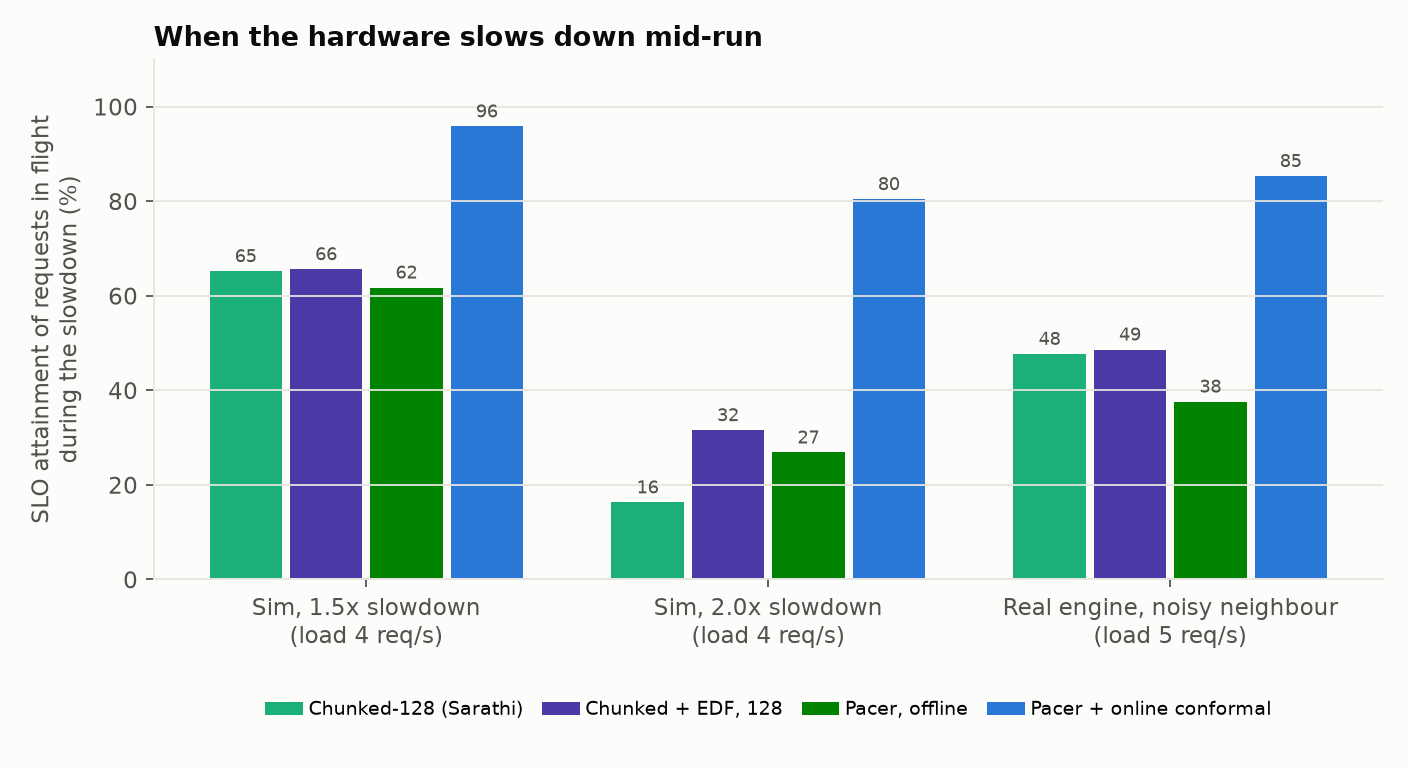
85%of requests kept on time by Pacer when the GPU slows down. The best standard scheduler: 49%.
+49%more serving capacity than the best fixed token budget on a real engine
76 yrsof daily S&P 500 data under Crash Replay's backtest engine
3products live and public, from GPU scheduling to tax law

Selected work

Built from first principles. Shipped.

Every number here comes from code you can run or a product you can open.

● Live Free public tool · Tax law

VALID

Tax answers, straight from the law.

Ask a federal tax question in plain English and get the rule that applies, what the answer depends on, and the exact text from the tax code or IRS publication behind it. Type the code from an IRS letter and it explains that too. Free, no account, and nothing you type is stored.

My role: designed the product and its architecture, and built it end to end.

tryvalid.live

Do I have to file a tax return?

RuleYou must file if your gross income is at least your filing threshold.
Depends onFiling statusGross incomeAge
Source26 U.S.C. §6012(a)(1) · IRS Pub. 501

Illustration. Not advice.
ML systems · LLM inference

Pacer

LLM serving that keeps its latency promises when the hardware doesn't.

An inference server built from scratch: paged KV cache, continuous batching, chunked prefill. Its scheduler predicts every step's latency, wraps the prediction in an online conformal risk bound, and orders requests with an exact deadline algorithm.

85%on-time under a real noisy neighbour (best baseline 49%)
8.5–10.4%observed risk against a 10% target, drift included
≥94%of best capacity on six workloads, two of them Azure production traces
When the hardware slows down, Pacer keeps 85% of requests within their latency target while standard schedulers fall to 49% and 38%.

● Live Quant · Market simulation

Crash Replay

Would you have sold in 2008? Find out with $10,000 and real prices.

Relive seven real crashes, from 1973 to 2022, one trading day at a time. You race buy-and-hold and a trend plus volatility-targeting strategy, then a permutation test against 2,000 random traders tells you whether your timing was skill or luck. Every trade gets a review, friends can challenge your score, and a new secret crash arrives every day.

0look-ahead: decide at the close, earn the next day
5 bpper trade, T-bill yield on cash, S&P dividends included
2,000random traders in every skill test

Systems design · Regulated finance

Crown Legacy AI

The Tampa company that publishes VALID, building software for regulated finance: tax and capitalization automation for CPA firms. I designed the product architecture.

crownlegacy.li

About

I like problems where the math and the machine meet. Schedulers that reason about risk. Backtests that can't cheat. Answers that cite the law.

Build the infrastructure. Prove it with math. Ship it to people.

Studying
Applied Mathematics + Computer Science, University of South Florida
ML systems
LLM inference, batching and KV-cache memory, latency modeling, GPU performance
Quant
Backtesting, volatility and risk models, conformal prediction, hypothesis testing
Engineering
Python, PyTorch, TypeScript, React and Next.js, FastAPI, Postgres

Contact

Let's build something hard.

Open to internships in ML systems, quantitative research and software engineering.